More than a third of medical students were distressed or struggling in 2025. Spot distress early by class year, give every student private results and resources in under 60 seconds, and build well-being habits that last a career.
A validated measurement and reporting platform, invented by Mayo Clinic, that tracks students’ risk of distress and adverse outcomes across fatigue, depression, burnout, anxiety/stress, and quality of life.
Built for ongoing use
Not a one-time survey. Students check in over time, and leaders see whether interventions worked.
What students get
Immediate, private results with resources customized to them. Under 60 seconds and 100% anonymous.
Benchmarks
National medical student norms, plus comparisons across your own class years.
How it’s validated
Peer-reviewed in four studies since 2010, validated as an accurate tool to predict and help identify students with severe distress.
What leaders get
Where to focus, which class years are at risk, whether it’s working, and the ROI case for leadership.
How does the Well-Being Index help medical students and schools?
Use cases
What problems does it solve for medical school leaders?
One validated instrument for every job that depends on student well-being data — from identifying distress early to building habits that last a career.
Deans of Student Affairs
Identify distress early
The challenge
Distress early in medical training can go unnoticed until a student falls behind, and every student who leaves is a loss to the profession.
How it helps
Identify students in distress early, in efforts to reduce drop out rates and promote success, with resources based on each student’s results.
Emphasizing the importance of wellness during schooling is the most effective tactic to reduce distress and harmful habits down the road.
How it helps
Regular self-assessment teaches students to connect events to their well-being, building the self-awareness and resiliency a successful career depends on.
Stigma keeps many medical students from seeking help, and distress often goes unrecognized until it shows up as burnout, an error, or a resignation.
How it helps
Objective, private feedback breaks through the “I’m fine” barrier, with resources customized to each person’s results and confidential crisis pathways built in. You see which groups need support, never who.
Leadership wants financial proof before they’ll fund what’s working, and EAP utilization numbers can’t show whether student distress is actually moving.
How it helps
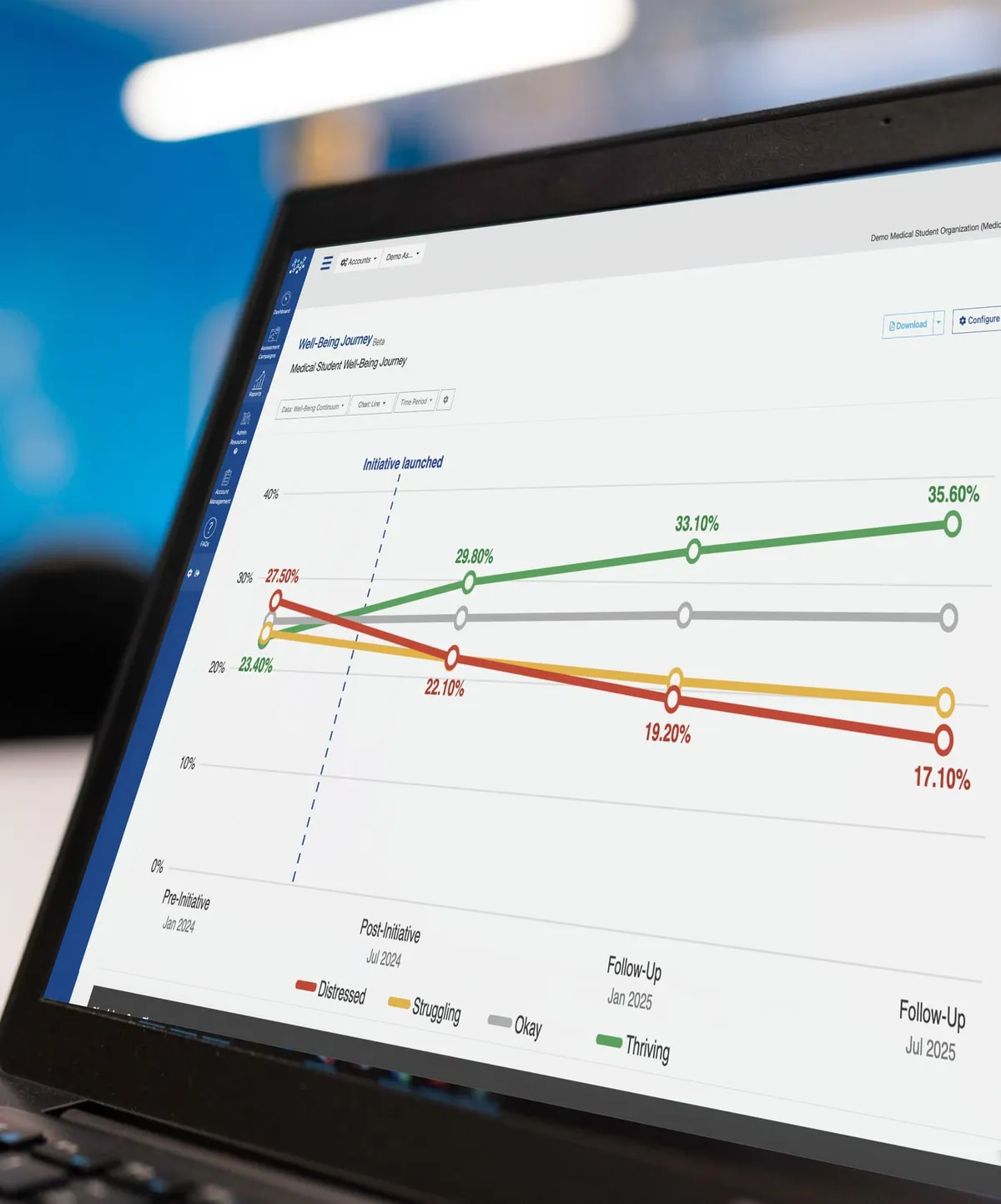
Validated student distress data at baseline and after every intervention, linked automatically in the Journey report, so you can show what moved the needle and build the board-ready case for next year’s investment.
Without data on your own medical students, well-being is an easy line item to cut, and national statistics alone rarely convince leadership to fund a bigger ask.
How it helps
Run a small pilot with a single class, show leadership real student distress data benchmarked nationally, and make the case for organization-wide funding before you ask for a bigger one.
once the anonymity threshold clears, not 2–4 weeks later
For leaders
What data do leaders get from the Well-Being Index?
Not just a score. Leaders see where distress is concentrated among their medical students, what’s driving it, and whether what they’re doing is working, with results available the moment the anonymity threshold clears.
Where distress is concentrated
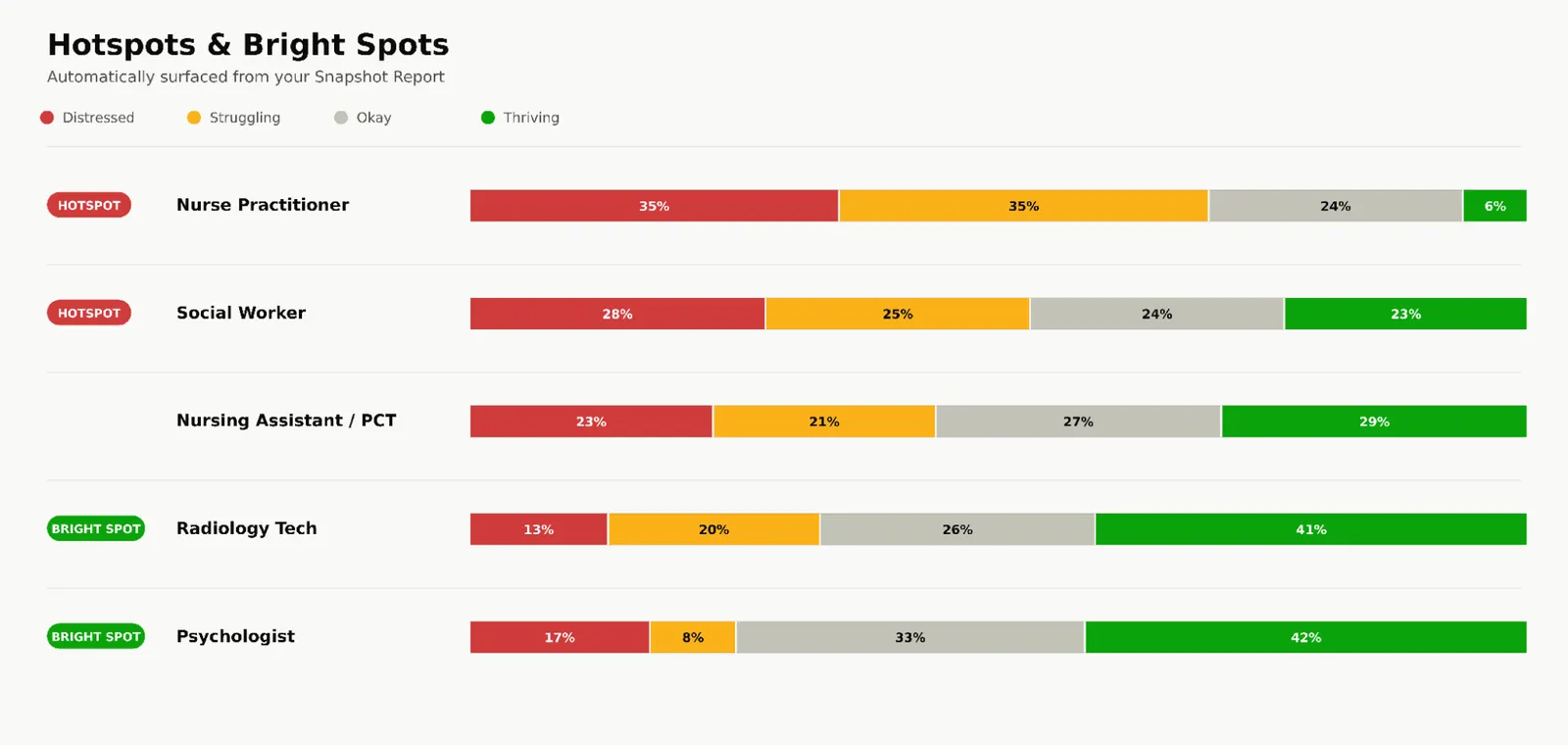
Results stratified into distressed, struggling, okay, and thriving, by department, role, shift, or tenure, with Hotspots & Bright Spots surfaced automatically.
Which groups to act on first
Your highest-risk groups ranked for you, with the potential organizational impact behind each risk area.
What’s driving it
Which dimensions of distress are behind each group’s results, never just a single burnout number.
How you compare
Every group benchmarked against national medical student norms, so you know whether a result is typical or a warning sign.
Whether it’s working
Trends across every assessment for your organization and sub-groups, before and after any intervention, so you walk into a budget conversation with evidence instead of a hunch.
What your people say they need
Tailored, confidential feedback questions added to the assessment, in multiple-choice or open-text, for a clearer picture of staff needs.
Anonymity thresholds are enforced by architecture, not policy. You see participation rates, not respondents.
Coming soon · Bring Your Own AI
Your results and national benchmarks, inside the AI you already use.
Connect Microsoft Copilot, Claude, ChatGPT, or any MCP-compatible AI to the Well-Being Index. Ask for the report, dashboard, or statistic you need, manage your assessment campaigns, and combine your results with any other data you already have.
The AI you already trust. No new tool and no new vendor to vet.
Validated benchmarks no general AI has. Mayo Clinic-developed national norms, one question away.
Assessment management. Your AI sets up the next assessment; you review and launch it.
Privacy unchanged. Group results only, for groups of 5 or more, every request logged.
Your organization's AIConnected to Well-Being Index
Things you'll be able to ask
Statistic“What share of our nurses are in high distress, compared with the national norm?”
Report“Build a board report on resident well-being since last spring.”
Dashboard“Make a dashboard of distress by unit and specialty.”
Campaign“Set up our spring assessment for all physicians and APPs.”
Your data“Compare distress by unit with our turnover data from HR.”
Ask about your Well-Being Index results…
Group results only. Groups smaller than 5 show as “too few to show.”
For medical students
What is the assessment like for medical students?
Every clinician who takes the assessment gets something back immediately: a clear, honest picture of where they stand, resources matched to what the data shows, and a guarantee that no one at their organization will ever see their individual answers.
A simple mobile assessment
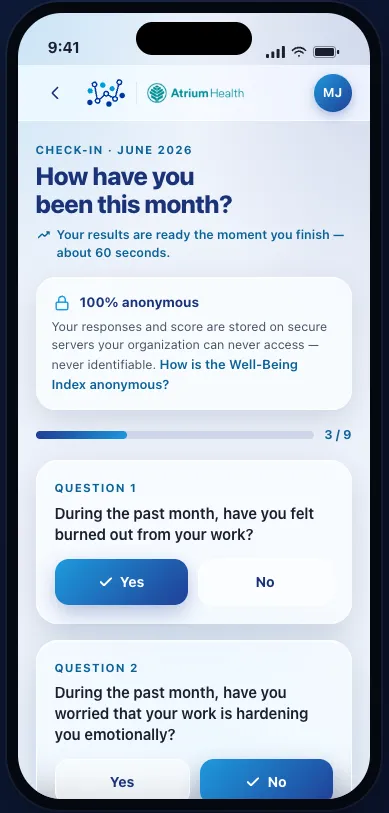
Fewer than ten simple yes/no and Likert-scale questions. Professionals take the validated 60-second assessment on the web or in the mobile app — in the break room or between patients.
Immediate, private benchmarking
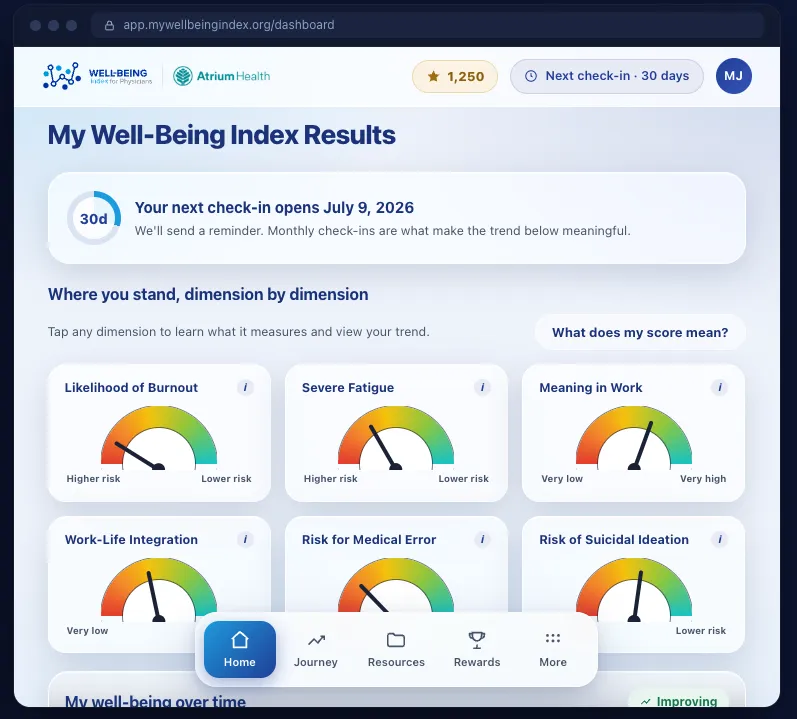
The moment they submit, clinicians see their own result. A participant’s score is compared to normative data from published national samples specific to the assessment version.
Resources matched to their results
Resources matched to their specific dimensions — not a generic list — and always accessible in the web tool or mobile app, not just the moment they finish.
Tracking over time
Every check-in scores across six clinically validated dimensions — always visible in their own dashboard, never just a single burnout number.
See it for yourself
See what your medical students and leaders would see
Explore a self-guided demo account loaded with sample data — the participant assessment and the full admin reporting suite, at your own pace. Or book a live walkthrough tailored to your organization.
How is the Medical Student Well-Being Index different from a survey?
A survey tells you how people felt on the day they answered. The Well-Being Index is a validated measurement and reporting platform: it shows you who is at risk, gives every participant something back the moment they finish, and keeps measuring so you know whether what you did actually worked.
Factor
Well-Being Index
Annual engagement survey
Generic burnout or pulse survey
What it measures
Risk of distress across six clinically validated dimensions
Morale and engagement
Usually burnout alone, or a single wellness score
Clinically validated
10+ years, peer-reviewed, tested to predict occupational and personal outcomes
Rarely — mostly proprietary
Varies; homegrown surveys are not validated
Time to complete
60 sec · fewer than ten questions
15–40 minutes
Varies
What participants get back
Immediate private results, benchmarked nationally, with resources customized to their results
Nothing individual
Rarely anything
Results for leaders
Instant, once anonymity threshold clears
2–4 weeks
Manual analysis
Benchmarks
National medical student norms for this role, plus comparisons across your own groups
Organization-level engagement norms
Rarely
Built for ongoing measurement
Yes — repeat check-ins and built-in Journey before/after reporting
Once a year
Manual, if at all
Anonymity
100% — architectural, enforced by threshold
Varies by vendor
Varies; often not guaranteed
Accreditation alignment
Joint Commission & ACGME-aligned
Not typically referenced
Not typically referenced
Already running an annual survey? We can walk you through the transition. Talk about switching →
The Medical Student Well-Being Index was invented by Mayo Clinic and is a reliable tool that helps medical schools and individuals screen psychological well-being. It evaluates fatigue, depression, burnout, anxiety/stress, and mental/physical quality of life in medical students. It has been validated as an accurate tool to predict and help identify students with severe distress for early intervention.
Promote Awareness
Promotes self-awareness at the absolute earliest stage of their journey in the medical field.
Identify Distress
Identifies students in distress early in efforts to reduce drop out rates and promote success.
Well-Being Resources
Provides valuable resources based upon individual results to increase well-being.
100% Anonymous
All data is 100% anonymous, providing a safe place to access resources on burnout.
Reporting Tools
Reporting features allow institutions to monitor student well-being and measure the effectiveness of wellness programs.
Plan your medical student well‑being program with an expert
Walk through your goals with a Well-Being Index expert — who to assess, how to roll it out to your medical students, and how to turn results into support leadership will fund. 20 minutes, no commitment.
How is the Medical Student Well-Being Index validated?
After initial development, Mayo Clinic tested the Well-Being Index in a number of professions and job types and evaluated its ability to predict a variety of different occupational and personal outcomes. The results were published in a series of peer-reviewed journal publications.
Who developed the Well-Being Index?
The Well-Being Index was developed at Mayo Clinic by Dr. Tait Shanafelt and Dr. Liselotte (Lotte) Dyrbye, who together have conducted multiple nationwide studies on clinician well-being and its implications on quality of care.
After years of research and internal use at Mayo Clinic, Mayo Clinic licensed the Well-Being Index to MedEd Web Solutions to create the online tool so that it can be offered to other institutions to use.
Tait Shanafelt, MD
Co-Developer of the Well-Being Index
Chief Wellness Officer for Stanford Medicine, Associate Dean of the Stanford School of Medicine, and the Jeanie and Stewart Ritchie Professor of Medicine. An international thought leader in physician well-being, Dr. Shanafelt previously co-directed the Mayo Clinic Department of Medicine Physician Well-Being Program, and his work focuses on shifting the conversation from physician resiliency to organizational, systemic, and cultural change.
Senior Associate Dean for Faculty Well-being and Chief Well-Being Officer at the University of Colorado School of Medicine, and Executive Director of CU THRIVE, the Center for Workplace Well-Being Research. Dr. Dyrbye previously co-directed Mayo Clinic’s Department of Medicine Physician Well-Being Program, and her work was the impetus for the National Academy of Medicine Action Collaborative on Clinician Well-Being and Resilience.
What does the data say about medical student distress?
How common
Why does medical student well-being matter?
Throughout medical training, providing an environment that promotes positive development is extremely important.
However, many studies have reported that students in medical education and training experience an environment that is overall not favorable for success.
Emphasizing the importance of wellness during schooling is the most effective tactic to reduce distress and harmful habits down the road. Teaching the habit of continual self-assessment will increase well-being awareness and the ability to associate the effect certain events have on their well-being. Reinforcing resiliency is perhaps one of the top skills a successful medical professional can have.
The trend · State of Well-Being 2025–2026
Is medical student well-being improving?
Not consistently. In the Well-Being Index’s 2025 data, 34.6% of medical students scored in the distressed or struggling categories, up slightly from 33.4% in 2024 and above 31.6% in 2018, though below the 2023 peak of 38.6%.
Medical student well-being, 2018–2025
Distressed or strugglingThriving
Medical student well-being, 2018–2025 (Well-Being Index, State of Well-Being 2025–2026 Report)
Year
Distressed or struggling
Thriving
2018
31.6%
32.1%
2019
32.4%
31.5%
2020
31.7%
32.1%
2021
33%
31.3%
2022
34.4%
30%
2023
38.6%
26%
2024
33.4%
32.5%
2025
34.6%
32.2%
34.6%distressed or struggling in 2025, up from 33.4% in 2024
32.2%thriving in 2025
+3.0 ptschange in distressed or struggling since 2018
Based on 5,006 medical student assessments in 2025
By year in school
Year 132.1%
Year 240.0%
Year 336.8%
Year 4+34.0%
Distressed or struggling in 2025, by year in school.
Medical Student Well-Being Index: common questions
01
What is the Medical Student Well-Being Index?
The Medical Student Well-Being Index was invented by Mayo Clinic and is a reliable tool that helps medical schools and individuals screen psychological well-being. It evaluates fatigue, depression, burnout, anxiety/stress, and mental/physical quality of life in medical students.
02
What percentage of medical students are distressed?
In 2025, 34.6% of medical students scored in the distressed or struggling categories of the Well-Being Index, across 5,006 assessments (Well-Being Index, State of Well-Being 2025–2026 Report).
03
Is medical student well-being improving?
Not consistently: 34.6% of medical students were distressed or struggling in 2025, up slightly from 33.4% in 2024 and above 31.6% in 2018, though below the 2023 peak of 38.6% (Well-Being Index, State of Well-Being 2025–2026 Report).
04
Which year of medical school is most stressful?
Second-year medical students report the most distress: 40.0% distressed or struggling in 2025, compared with 36.8% in year 3, 34.0% in year 4 or later, and 32.1% in year 1 (Well-Being Index, State of Well-Being 2025–2026 Report).
05
Is the Medical Student Well-Being Index validated?
It has been validated as an accurate tool to predict and help identify students with severe distress for early intervention.
06
Why assess well-being during medical school?
Emphasizing the importance of wellness during schooling is the most effective tactic to reduce distress and harmful habits down the road. Teaching the habit of continual self-assessment will increase well-being awareness and the ability to associate the effect certain events have on their well-being.
07
Is the Medical Student Well-Being Index anonymous?
All data is 100% anonymous, providing a safe place to access resources on burnout.
Take Action Today
Because your students’ well‑being is the future of medicine.
Your medical students are your organization’s greatest asset—and greatest vulnerability. The Medical Student Well-Being Index gives you the tools to protect both.
Get a free demo or schedule your implementation consultation and join the 1,000+ healthcare organizations already transforming well-being with evidence-based precision.

 Deans of Student Affairs