Nearly half of dental professionals were distressed or struggling in 2025. See which teams and providers are at risk before it leads to errors or turnover, and give every provider private results and support in under 60 seconds.
A validated measurement and reporting platform, invented by Mayo Clinic, that tracks dental professionals’ risk of distress and adverse outcomes, including concern for a recent dental error and intent to leave.
Built for ongoing use
Not a one-time survey. Dental teams check in over time, and leaders see whether interventions worked.
What dental teams get
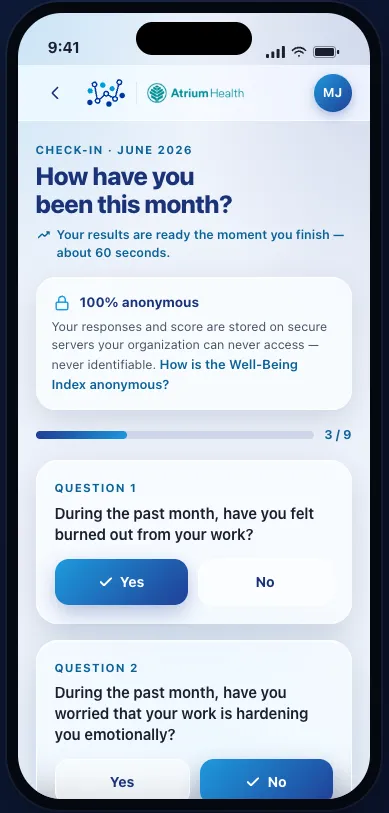
Immediate, private results with resources customized to them. Under 60 seconds and 100% anonymous.
Benchmarks
National dental averages, plus internal benchmarking across your own roles and locations.
How it’s validated
Peer-reviewed in BDJ Open, validated as a screening tool for distress and well-being in dentists.
What leaders get
Where to focus, which teams are at risk, whether it’s working, and the ROI case for leadership.
How does the Well-Being Index help dental teams and practices?
Use cases
What problems does it solve for dental leaders?
One validated instrument for every job that depends on dental well-being data — from patient safety to keeping your providers.
HR Directors & CHROs
Cut dental turnover
The challenge
Intent to leave is one of the dimensions the index measures, yet most practices only learn a provider is leaving when the notice arrives.
How it helps
Identify hotspot roles and locations before resignations happen, target retention spend precisely where the data shows it will matter most, and track whether it worked.
Leadership wants financial proof before they’ll fund what’s working, and EAP utilization numbers can’t show whether dental distress is actually moving.
How it helps
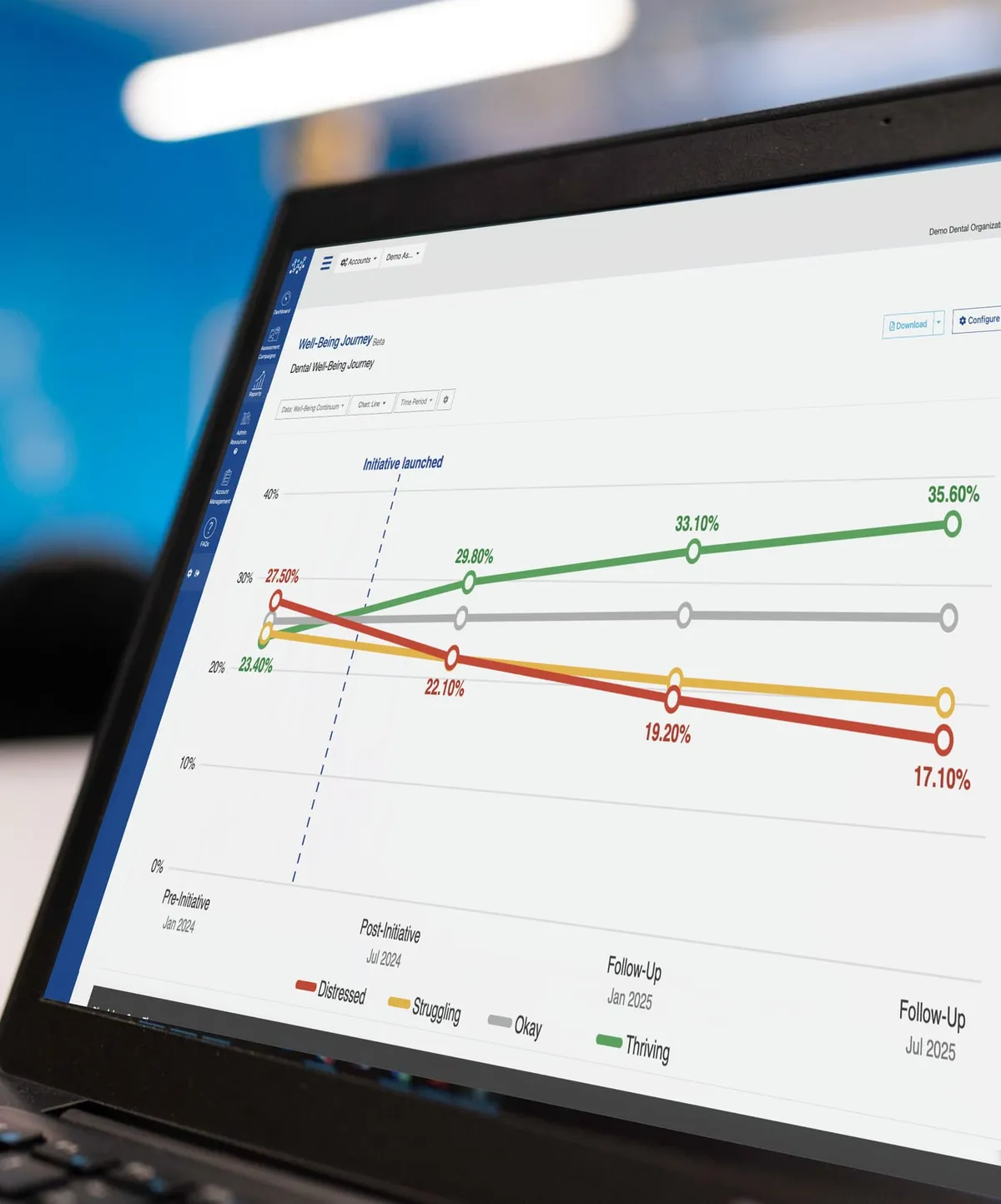
Validated dental distress data at baseline and after every intervention, linked automatically in the Journey report, so you can show what moved the needle and build the board-ready case for next year’s investment.
Without data on your own dental professionals, well-being is an easy line item to cut, and national statistics alone rarely convince leadership to fund a bigger ask.
How it helps
Run a small pilot with a single location, show leadership real dental distress data benchmarked nationally, and make the case for organization-wide funding before you ask for a bigger one.
Stigma keeps many dental professionals from seeking help, and distress often goes unrecognized until it shows up as burnout, an error, or a resignation.
How it helps
Objective, private feedback breaks through the “I’m fine” barrier, with resources customized to each person’s results and confidential crisis pathways built in. You see which groups need support, never who.
once the anonymity threshold clears, not 2–4 weeks later
For leaders
What data do leaders get from the Well-Being Index?
Not just a score. Leaders see where distress is concentrated among their dental professionals, what’s driving it, and whether what they’re doing is working, with results available the moment the anonymity threshold clears.
Where distress is concentrated
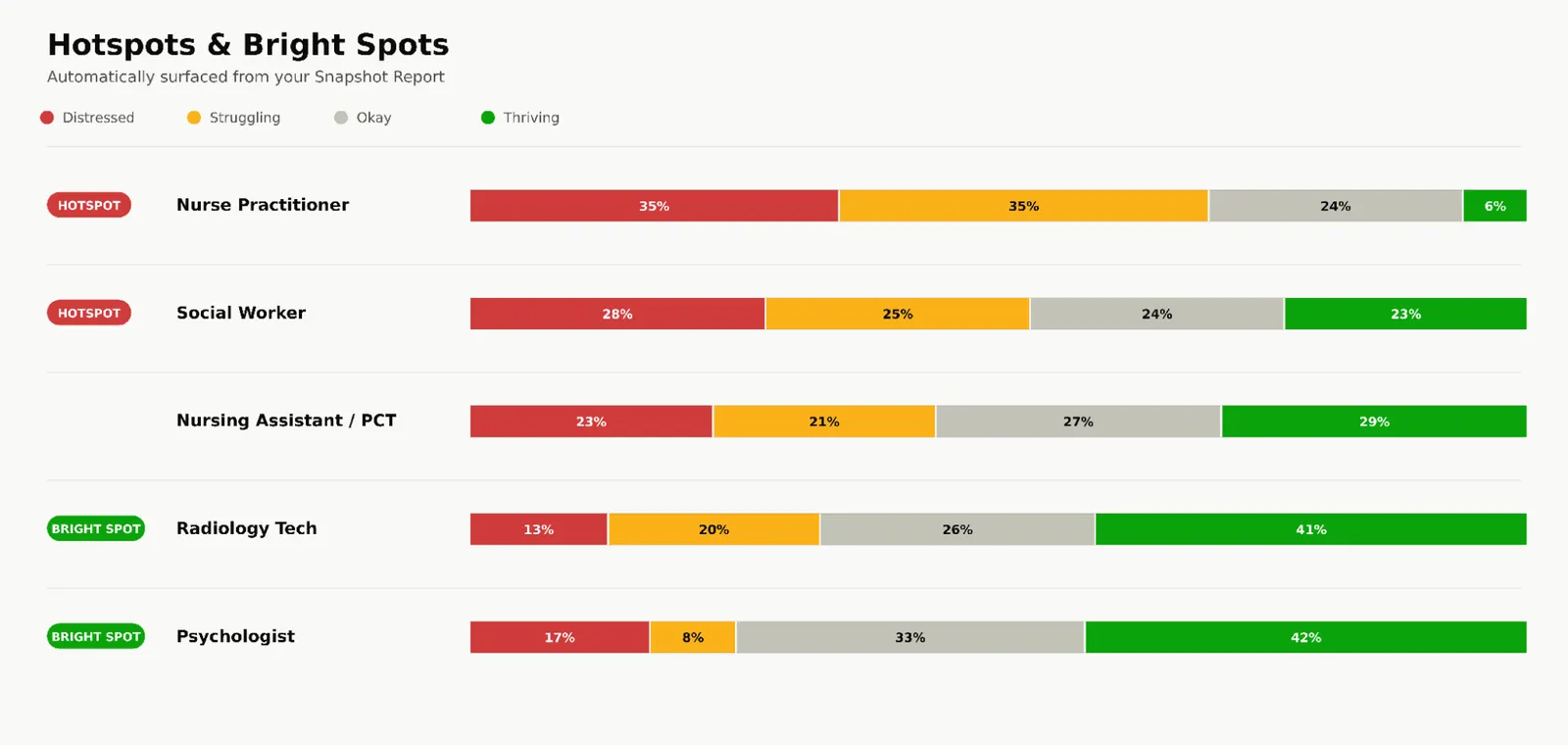
Results stratified into distressed, struggling, okay, and thriving, by department, role, shift, or tenure, with Hotspots & Bright Spots surfaced automatically.
Which groups to act on first
Your highest-risk groups ranked for you, with the potential organizational impact behind each risk area.
What’s driving it
Which dimensions of distress are behind each group’s results, never just a single burnout number.
How you compare
Every group benchmarked against national dental norms, so you know whether a result is typical or a warning sign.
Whether it’s working
Trends across every assessment for your organization and sub-groups, before and after any intervention, so you walk into a budget conversation with evidence instead of a hunch.
What your people say they need
Tailored, confidential feedback questions added to the assessment, in multiple-choice or open-text, for a clearer picture of staff needs.
Anonymity thresholds are enforced by architecture, not policy. You see participation rates, not respondents.
Coming soon · Bring Your Own AI
Your results and national benchmarks, inside the AI you already use.
Connect Microsoft Copilot, Claude, ChatGPT, or any MCP-compatible AI to the Well-Being Index. Ask for the report, dashboard, or statistic you need, manage your assessment campaigns, and combine your results with any other data you already have.
The AI you already trust. No new tool and no new vendor to vet.
Validated benchmarks no general AI has. Mayo Clinic-developed national norms, one question away.
Assessment management. Your AI sets up the next assessment; you review and launch it.
Privacy unchanged. Group results only, for groups of 5 or more, every request logged.
Your organization's AIConnected to Well-Being Index
Things you'll be able to ask
Statistic“What share of our nurses are in high distress, compared with the national norm?”
Report“Build a board report on resident well-being since last spring.”
Dashboard“Make a dashboard of distress by unit and specialty.”
Campaign“Set up our spring assessment for all physicians and APPs.”
Your data“Compare distress by unit with our turnover data from HR.”
Ask about your Well-Being Index results…
Group results only. Groups smaller than 5 show as “too few to show.”
For dental professionals
What is the assessment like for dental professionals?
Every clinician who takes the assessment gets something back immediately: a clear, honest picture of where they stand, resources matched to what the data shows, and a guarantee that no one at their organization will ever see their individual answers.
A simple mobile assessment
Fewer than ten simple yes/no and Likert-scale questions. Professionals take the validated 60-second assessment on the web or in the mobile app — in the break room or between patients.
Immediate, private benchmarking
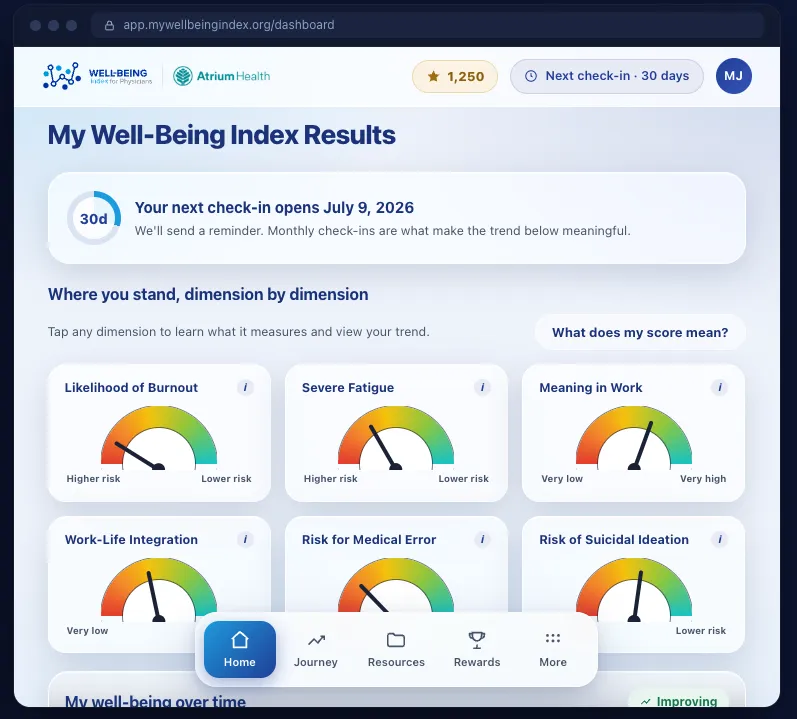
The moment they submit, clinicians see their own result. A participant’s score is compared to normative data from published national samples specific to the assessment version.
Resources matched to their results
Resources matched to their specific dimensions — not a generic list — and always accessible in the web tool or mobile app, not just the moment they finish.
Tracking over time
Every check-in scores across six clinically validated dimensions — always visible in their own dashboard, never just a single burnout number.
See it for yourself
See what your dental professionals and leaders would see
Explore a self-guided demo account loaded with sample data — the participant assessment and the full admin reporting suite, at your own pace. Or book a live walkthrough tailored to your organization.
How is the Dental Well-Being Index different from a survey?
A survey tells you how people felt on the day they answered. The Well-Being Index is a validated measurement and reporting platform: it shows you who is at risk, gives every participant something back the moment they finish, and keeps measuring so you know whether what you did actually worked.
Factor
Well-Being Index
Annual engagement survey
Generic burnout or pulse survey
What it measures
Risk of distress across six clinically validated dimensions
Morale and engagement
Usually burnout alone, or a single wellness score
Clinically validated
10+ years, peer-reviewed, tested to predict occupational and personal outcomes
Rarely — mostly proprietary
Varies; homegrown surveys are not validated
Time to complete
60 sec · fewer than ten questions
15–40 minutes
Varies
What participants get back
Immediate private results, benchmarked nationally, with resources customized to their results
Nothing individual
Rarely anything
Results for leaders
Instant, once anonymity threshold clears
2–4 weeks
Manual analysis
Benchmarks
National dental norms for this role, plus comparisons across your own groups
Organization-level engagement norms
Rarely
Built for ongoing measurement
Yes — repeat check-ins and built-in Journey before/after reporting
Once a year
Manual, if at all
Anonymity
100% — architectural, enforced by threshold
Varies by vendor
Varies; often not guaranteed
Accreditation alignment
Joint Commission & ACGME-aligned
Not typically referenced
Not typically referenced
Already running an annual survey? We can walk you through the transition. Talk about switching →
The interactive online tool allows dental professionals to anonymously measure their well-being in less than one minute, access custom resources, compare their scores to peers’ and national averages, and track their progress over time. The Dental Well-Being Index also allows organizations to collect the data needed to pinpoint the causes of distress and make meaningful changes to maximize the mental health of participants.
100% Anonymous
Remove the fear of self-assessing and the implications of not scoring well. All data is stored in secure cloud servers and provided to administrators in a de-identified aggregate format.
Fewer Than Ten Questions
Maximize participation with the online assessment that contains fewer than ten simple yes/no or slider-scale questions and takes less than 1 minute to complete.
Evidence-Based
Guide wellness initiatives with data, not guesses. Get an accurate view of well-being and track the effectiveness of your wellness programming.
Advanced Reporting
Analyze your data with advanced segmenting, national and internal benchmarking, resource access reporting, participant feedback and more.
Customized Resources
Support participants with customized local and national resources to help them improve their well-being.
6 Dimensions, Not 1
Get a holistic view of well-being. The Dental Well-Being Index goes beyond burnout to measure 6 dimensions of distress and well-being.
Plan your dental well‑being program with an expert
Walk through your goals with a Well-Being Index expert — who to assess, how to roll it out to your dental professionals, and how to turn results into support leadership will fund. 20 minutes, no commitment.
After initial development, Mayo Clinic tested the Well-Being Index in a number of professions and job types and evaluated its ability to predict a variety of different occupational and personal outcomes. The results were published in a series of peer-reviewed journal publications.
Who developed the Well-Being Index?
The Well-Being Index was developed at Mayo Clinic by Dr. Tait Shanafelt and Dr. Liselotte (Lotte) Dyrbye, who together have conducted multiple nationwide studies on clinician well-being and its implications on quality of care.
After years of research and internal use at Mayo Clinic, Mayo Clinic licensed the Well-Being Index to MedEd Web Solutions to create the online tool so that it can be offered to other institutions to use.
Tait Shanafelt, MD
Co-Developer of the Well-Being Index
Chief Wellness Officer for Stanford Medicine, Associate Dean of the Stanford School of Medicine, and the Jeanie and Stewart Ritchie Professor of Medicine. An international thought leader in physician well-being, Dr. Shanafelt previously co-directed the Mayo Clinic Department of Medicine Physician Well-Being Program, and his work focuses on shifting the conversation from physician resiliency to organizational, systemic, and cultural change.
Senior Associate Dean for Faculty Well-being and Chief Well-Being Officer at the University of Colorado School of Medicine, and Executive Director of CU THRIVE, the Center for Workplace Well-Being Research. Dr. Dyrbye previously co-directed Mayo Clinic’s Department of Medicine Physician Well-Being Program, and her work was the impetus for the National Academy of Medicine Action Collaborative on Clinician Well-Being and Resilience.
With one of the highest rates of distress in healthcare, strategic initiatives to promote the well-being of dental professionals are needed like never before. The Well-Being Index is your partner in protecting your providers.
According to recent research focused on dental professional well-being, over 84% of dentists and 26% of dental auxiliaries have reported feelings of burnout. Furthermore, in a 2021 American Dental Association member survey, it was found that the percentage of dentists diagnosed with anxiety has more than tripled over the past two decades.
If left unaddressed, this distress and its consequences can put the health of patients and the lives of dental providers at risk. It’s clear that our dental professionals are in need of support. It’s time to go beyond dentist burnout and protect the well-being of this vital population.
The trend · State of Well-Being 2025–2026
Is dental professional well-being improving?
It improved in 2025, but remains above earlier levels. In the Well-Being Index’s 2025 data, 45.3% of dental professionals scored in the distressed or struggling categories, down from 48.9% in 2024 but up from 39.0% in 2022, when dental tracking began.
Dental professional well-being, 2022–2025
Distressed or strugglingThriving
Dental professional well-being, 2022–2025 (Well-Being Index, State of Well-Being 2025–2026 Report)
Year
Distressed or struggling
Thriving
2022
39%
34.5%
2023
41.2%
36.7%
2024
48.9%
28.3%
2025
45.3%
30.5%
45.3%distressed or struggling in 2025, down from 48.9% in 2024
30.5%thriving in 2025
+6.3 ptschange in distressed or struggling since 2022
The Dental Well-Being Index is a validated measurement and reporting platform, invented by Mayo Clinic, that measures multiple dimensions of distress and well-being, including quality of life, fatigue, burnout, concern for a recent dental error, and intent to leave the current job.
02
What percentage of dental professionals are distressed?
In 2025, 45.3% of dental professionals scored in the distressed or struggling categories of the Well-Being Index, across 1,129 assessments (Well-Being Index, State of Well-Being 2025–2026 Report).
03
Is dental professional well-being improving?
It improved in 2025, but remains above earlier levels: 45.3% of dental professionals were distressed or struggling, down from 48.9% in 2024 but up from 39.0% in 2022 (Well-Being Index, State of Well-Being 2025–2026 Report).
04
Which dental professionals report the most distress?
Younger dental professionals report the most distress: 51.9% of those under 35 and 51.9% of those aged 35–44 were distressed or struggling in 2025, compared with 20.2% of those 65 and older (Well-Being Index, State of Well-Being 2025–2026 Report).
05
How common is dentist burnout?
According to recent research focused on dental professional well-being, over 84% of dentists and 26% of dental auxiliaries have reported feelings of burnout.
06
How long does the assessment take?
The online assessment contains fewer than ten simple yes/no or slider-scale questions and takes less than 1 minute to complete.
07
Is the Dental Well-Being Index anonymous?
Yes. All data is stored in secure cloud servers and provided to administrators in a de-identified aggregate format.
Take Action Today
Because your dental team’s well‑being is your practice’s future.
Your dental professionals are your organization’s greatest asset—and greatest vulnerability. The Dental Well-Being Index gives you the tools to protect both.
Get a free demo or schedule your implementation consultation and join the 1,000+ healthcare organizations already transforming well-being with evidence-based precision.

 HR Directors & CHROs