
Clinician well-being
is your retention strategy.
Now you can measure it.
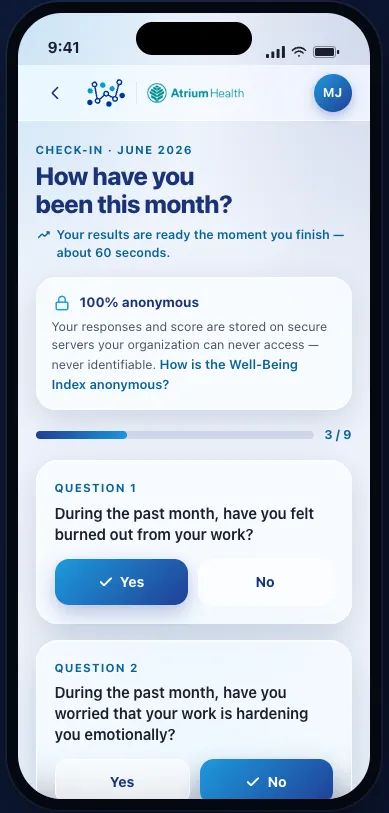
The only Mayo Clinic-validated well-being assessment that measures 6 dimensions of distress and well-being in under 60 seconds. See where your teams stand today, and prove what's moving the needle over time.
Clinician distress is a retention, patient safety, and financial health problem.
Protecting your team's well-being is the goal — full stop. But it's the business case, not the moral one, that unlocks the budget and organizational support to act on it. These are the numbers that turn a values statement into a funded initiative.
Burnout costs U.S. healthcare nearly $6B a year
Turnover, medical errors, and malpractice exposure — money already walking out the door, industry-wide.
Struggling physicians believe they're performing fine
Self-report alone won't surface this. Without measurement, your organization is blind to the real scope of the problem.
Of physicians find meaning in their work — yet burnout persists
Meaning and burnout aren't opposites. Teams can love the work and still be breaking down under it.
Of nurses are distressed or struggling
The gap to the overall average widened from 7.8 to 10.6 points in a single year — with ICU nurses and LPNs carrying the highest compounding risk.
Leading cause of death among U.S. resident trainees: suicide
The risk is measurable with the right tool — and addressable before it becomes a crisis.
Used their Well-Being Index data to prove a $370K return.
See the ROI breakdown →Burnout is one signal. Six dimensions tell the full story.
Capture the full picture — the Mayo Clinic-validated dimensions that actually predict risk of turnover, errors, and harm in healthcare teams.
Meaning in Work
Whether clinicians experience work as purposeful service — or a burden to survive.
Likelihood of Burnout
Emotional exhaustion and depersonalization linked to medical errors and reduced empathy.
Severe Fatigue
The depleted cognitive state that compromises clinical judgment and procedural safety.
Work-Life Integration
Strongly linked to 2-year and 5-year attrition in clinical and academic medicine.
Quality of Life
Catches compassion fatigue and moral injury before they become a resignation.
Suicidal Ideation Risk
Captured anonymously, at the cohort level, with crisis pathways built into the tool.
Used Well-Being Index insights to combat attrition.
See their process →The data you need to improve well-being.
Every improvement effort starts with a baseline. See exactly where your teams stand today, and prove what's moving the needle over time.
Clear results the moment they finish.
Every clinician sees their own six-dimension result instantly and privately, with resources matched to exactly what the data shows.
Your organization's well-being, at a glance.
The Snapshot report aggregates results the moment your first campaign closes — by department, role, shift, or any segment that matters to you.
Proof that what you're doing is working.
Run the same assessment before and after any intervention. The Journey report links every cycle automatically and shows exactly what changed — and by how much.
Add your own questions to the check-in.
Append organization-specific questions to the end of the validated assessment — agree/disagree, rating scale, multiple choice, or free text. Responses route straight to your reporting, alongside the six validated dimensions.
Built for every role — and every leader who supports them.
One validated instrument, calibrated for the professionals who take it and trusted by the leaders who act on the results.








 Chief Wellness Officers & Well-Being Leaders
Prove Wellness ROI
Replace EAP utilization guesswork with validated distress data and show your board exactly what their investment bought.
 CMOs, CNOs & Quality Leaders
Reduce Medical Errors
Anchor patient safety strategy in validated measurement, and catch the fatigue and burnout patterns that precede a safety event.
 Wellness Committees & Pilot Leads
Secure Well-Being Budget
Run a small pilot, show real distress data to leadership, and make the case for organization-wide funding — before you ask for a bigger one.
 GME Program Directors
Meet ACGME Standards
The instrument validated specifically for residents and fellows, aligned to Section VI.C, with documentation ready for your next review.
 HR Directors & CHROs
Cut Clinician Turnover
Identify hotspot roles and shifts before resignations happen, and target retention spend precisely where the data says it matters.
Not all well-being measurement is created equal.
Most organizations build something in-house, bolt a few burnout questions onto a generic engagement survey, or lean on instruments designed decades ago for a different workforce. See how the only Mayo Clinic-validated instrument compares.
| Factor | Well-Being Index | Other Well-Being Platforms | In-House / Homegrown Surveys |
|---|---|---|---|
| Clinically validated | 10+ years, peer-reviewed | Rarely — mostly proprietary, unpublished | No independent validation |
| Dimensions measured | 6 — burnout, fatigue, meaning, work-life integration, quality of life, suicidal ideation risk | Usually 1 (engagement or burnout only) | Whatever the survey author chose |
| Role-specific versions | 8 validated versions | Usually one generic version | One-size-fits-all, if standardized at all |
| Number of questions | 9 questions | 20–40+ typical | No standard — often 50+ |
| Time to complete | 60 sec · 9 questions | 10–30 min typical | Varies widely, often long |
| Suicide / crisis risk detection | Yes — validated, anonymous, cohort-level | Rarely included | Essentially never |
| Anonymity guarantee | 100% — architectural, enforced by threshold | Varies by vendor | Rarely enforced systematically |
| National benchmarking | ~1M assessments, national clinical norms | Limited or no external benchmark | No external benchmark |
| Accreditation alignment | Joint Commission & ACGME-aligned | Not typically referenced | Not referenced |
| Built for before/after tracking | Yes — built-in Journey reporting | Manual or separate engagement | Manual, inconsistent |
| Implementation | Self-service, live in days to weeks | Often requires a consultant or facilitator | Requires internal IT or survey team build |
You can't improve what you don't measure. Start today.
"A key organizational strategy to improving clinician well-being is to measure it, develop and implement interventions, and then re-measure it." Every day without a baseline is a day of guessing at what's costing you clinicians, safety, and budget. Pick your path below.
Talk with an Expert
Get a custom quote and deployment plan tailored to your organization.
Book a meeting → 30 minutes · tailored to youBook an Expert-Guided Demo
A live walkthrough with a Well-Being Index expert, tailored to your organization, your clinical populations, and your use case.
Book your demo → Free · ~20 minutesGet a Free ROI Analysis
See what burnout is really costing your organization, and get the numbers you need to bring to leadership.
Get your ROI analysis →