
All Groups 2024

Comparison Across Practice Type
This section compares well-being across various practice types as well as responses to individual Well-Being Index questions. We use the Well-Being Snapshot & Well-Being Continuum for comparing well-being across groups.
Well-Being Over Time
About This Report
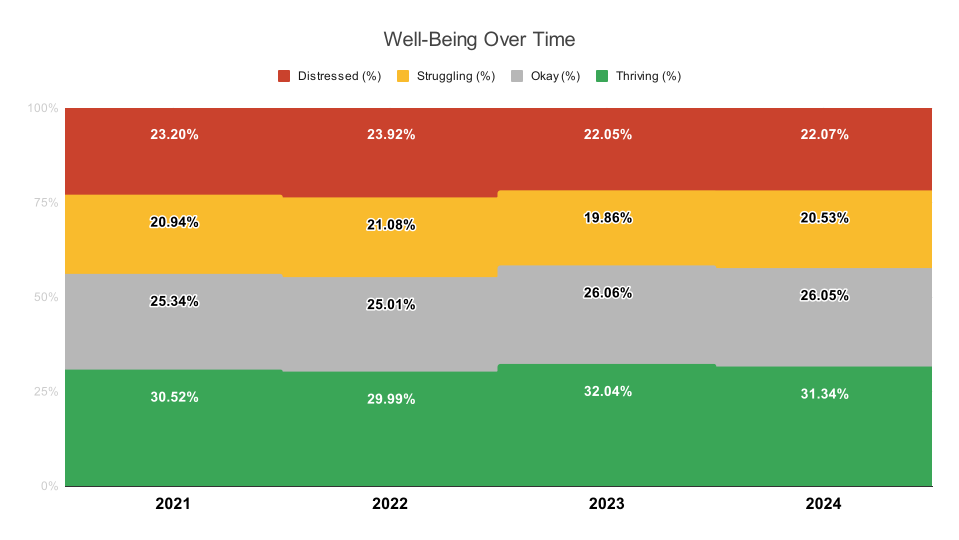
This report shows the Well-Being over time combining the data from all practice types available since 2021. This includes all groups except Pharmacy & Dentistry for consistency with previous years. View the associated risks and likelihood of outcomes with each category of the Well-Being Continuum for each group.
Connecting The Dots
It is important to note that while aiming to reduce the proportion of individuals scoring as Distressed or Struggling is the goal, well-being is ultimately tied to so many dimensions of living which can contribute to a great deal of variability in well-being throughout the course of a year. This is indicative of the continual need for organizational focus on well-being and ongoing tracking of where staff are at. The overall annual report here demonstrates that year over year there will be some dimension of well-being which is more heavily impacted and contributing to distress and struggling scores for participants.
Well-Being Snapshot By Practice Type
About These Reports
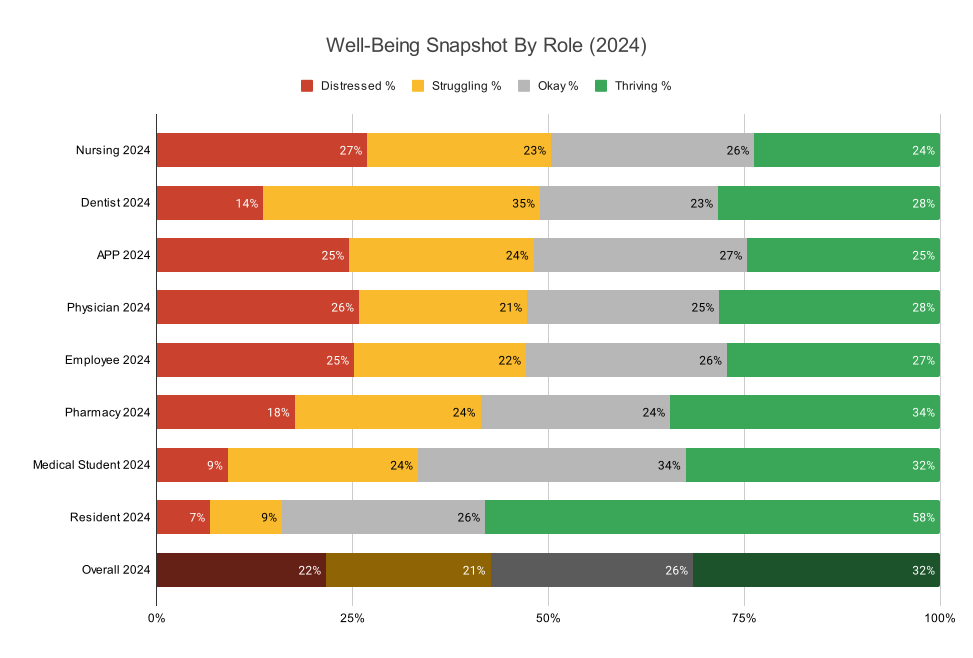
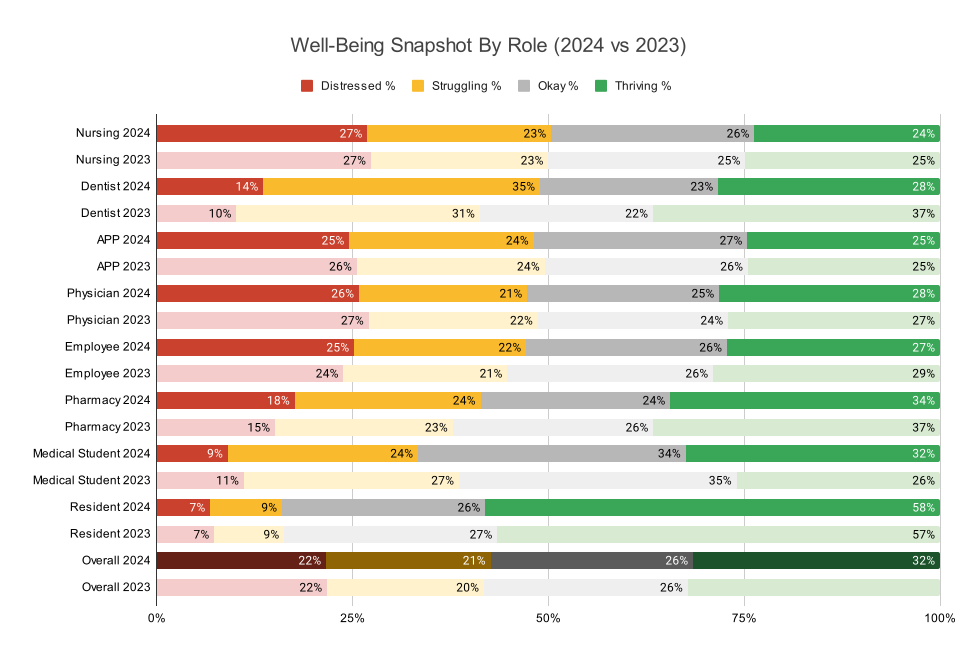
This report shows the Well-Being Continuum sorted by highest percentage of a combination of Distressed & Struggling to lowest in 2024. The data for 2023 is directly below the 2024 data for the associated group. The bottom bar shows a combination of data from all groups for 2024 vs. 2023. View the associated likelihood of positive & negative outcomes with each category of the Well-Being Continuum for each group.
Connecting The Dots
The Nursing population continues to maintain the highest percent of a combination of Distressed and Struggling assessments over the past 2 years despite a drop in Mean Distress score comparing 2023 and 2024 data to to 2022.
There was also a noticeable jump in distressed and struggling scores for Dentists. They’re the group with the single largest change in 2024 compared to 2023.
Burnout By Practice Type
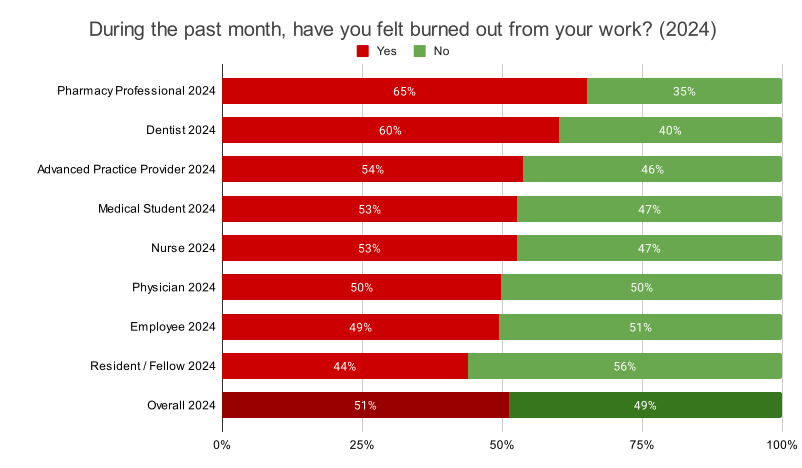
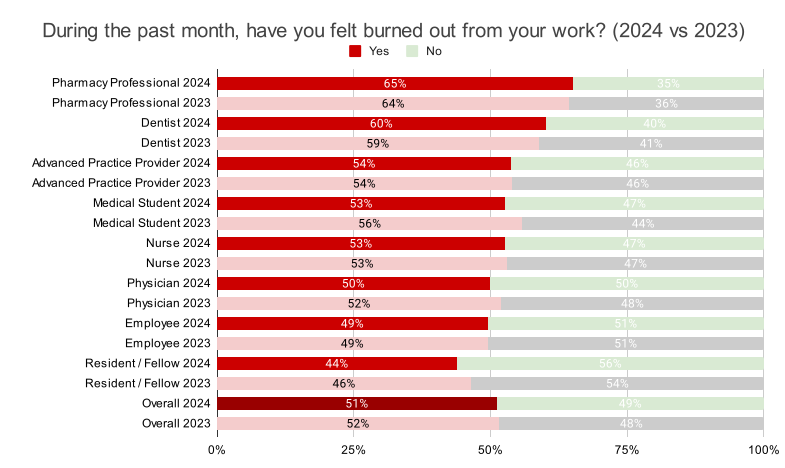
Responses to the Well-Being Index question, “During the past month, have you felt burned out from your work?”
About These Report
This report highlights the groups with the highest to lowest percentage of assessments that have indicated feeling burnout from their work in 2024 and compared to 2023.
Connecting The Dots
While the Well-Being Index is not just a measure for burnout, the outcome of burnout as it relates to depersonalization and emotional exhaustion are critically assessed for in the assessment. Among those who completed the assessment in 2024, more than half reported feeling burned out from their role.
Emotional Hardening By Practice Type
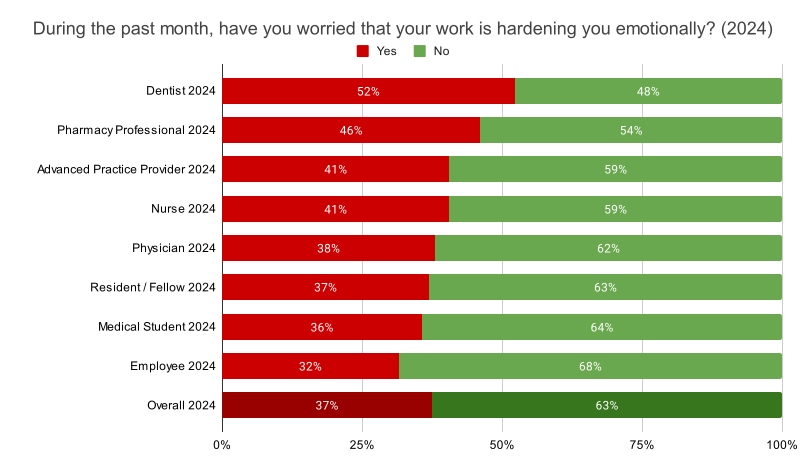
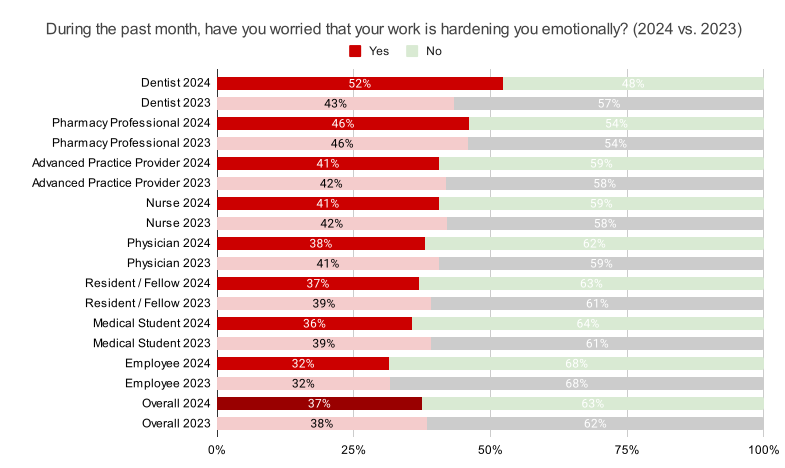
Responses to the Well-Being Index question, “During the past month, have you worried that your work is hardening you emotionally?”
About These Report
This report highlights the groups with the highest to lowest percentage of assessments that have indicated feeling worried that their work is hardening them emotionally in 2024 and compared to 2023.
Connecting The Dots
Emotional hardening is an outcome which impacts all facets of a individual’s life. From their interactions with patients, colleagues, leaders, to their personal lives, this outcome is one which is felt by both the individual and those that they interact with.
Emotional Problems By Practice Type
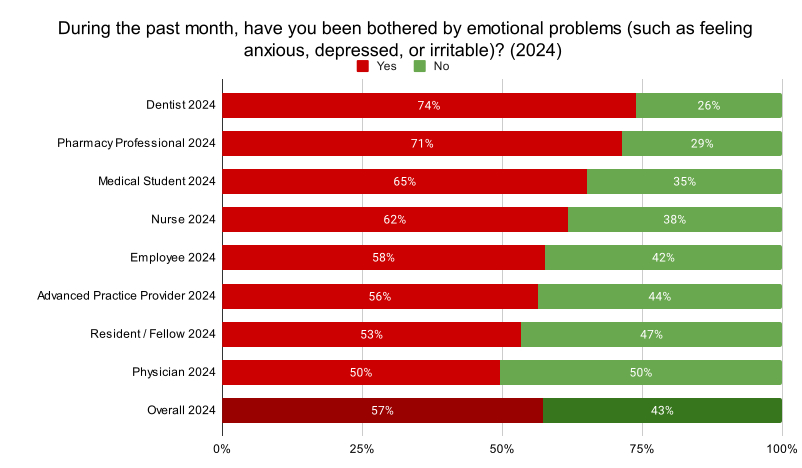
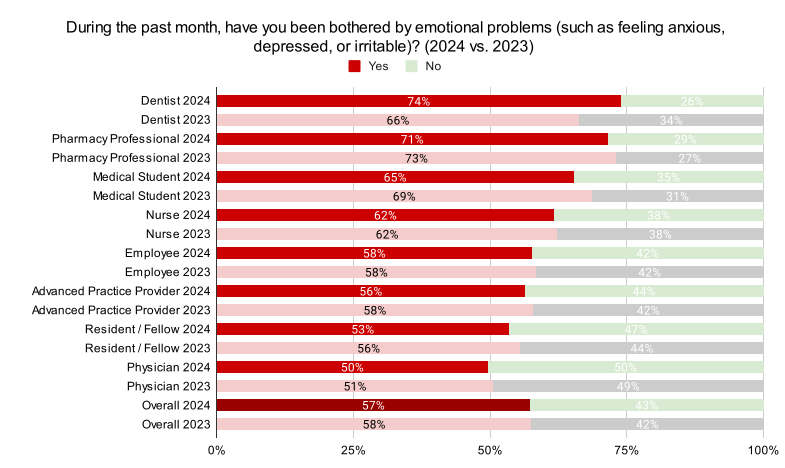
Responses to the Well-Being Index question “During the past month, have you been bothered by emotional problems (such as feeling anxious, depressed, or irritable)?”
About These Reports
This report highlights the occupations with the highest to lowest percentage of assessments that have indicated feeling bothered by emotional problems in 2024 and compared to 2023.
Connecting The Dots
While there was a slight decrease in the percent of Yes answers for many groups, Dentists had the highest percentage of assessments indicating emotional hardening; feeling down, depressed, or hopeless; and being bothered by emotional problems with Pharmacy close behind. Responses to this question are of specific note as they relate directly to risk for suicidal ideation.
Meaning in Work By Practice Type
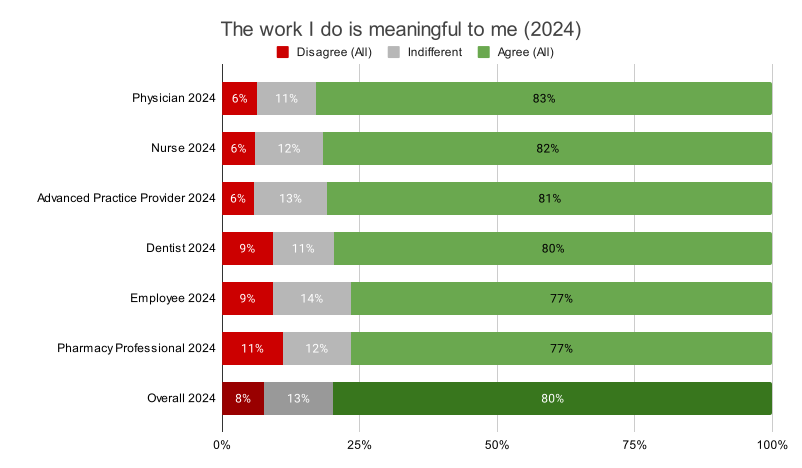
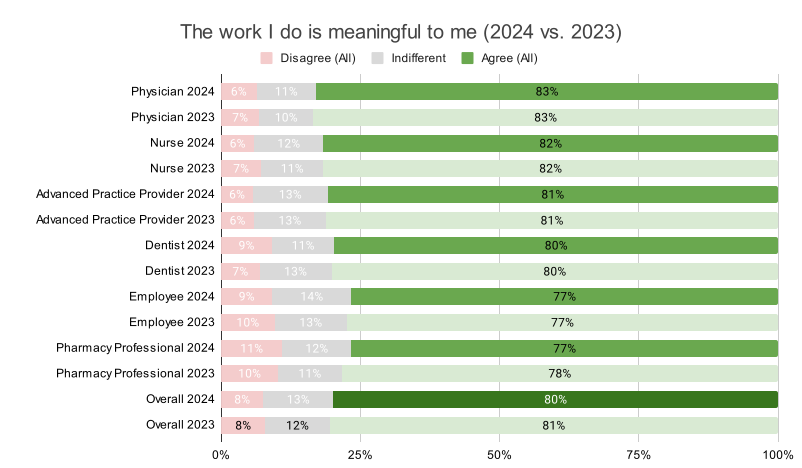
Responses to the Well-Being Index question “Please rate your level of agreement with the following statement: The work I do is meaningful to me.”
About These Reports
This report highlights the occupations with the highest to lowest percentage of assessments that have indicated the work they do is meaningful to them in 2024 and compared to 2023.
Responses to this question include Very Strongly Disagree, Strongly Disagree, Disagree, Indifferent, Agree, Strongly Agree, Very Strongly Agree. All Disagrees were combined and all All Agrees were combined for visual clarity.
Connecting The Dots
Among the Pharmacy Professional and Dentists groups these were the only two professions, whose responses this year increased in the proportion of participants who reported that they do not agree with their work being meaningful to them. The item of the Well-Being Index, which pertains to meaning in work, is one of two items that provide mitigation against the adverse outcomes being assessed for. This is notable, as these professions have been among some of the more recent professions to begin implementing well-being efforts. These professions have been later in their adoption to the well-being work as their roles potentially isolate them from the larger initiatives impacting the healthcare industry. These groups are potentially under served in well-being initiatives and the impact of that can be felt by the professionals in those occupations.
Work/Life Integration by Practice Type
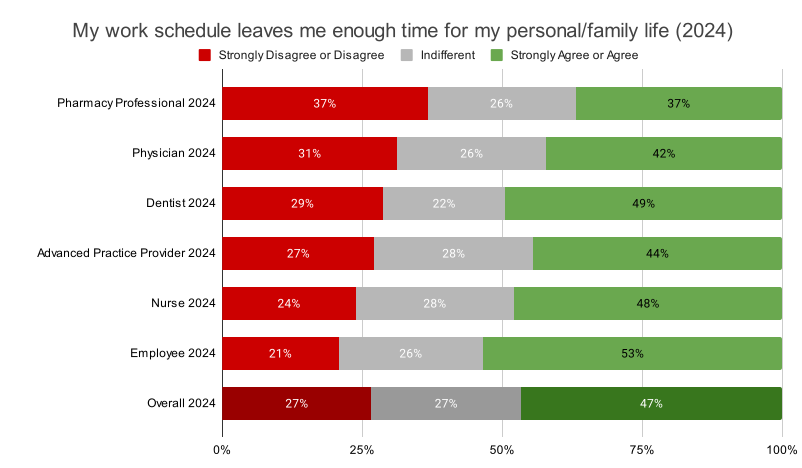
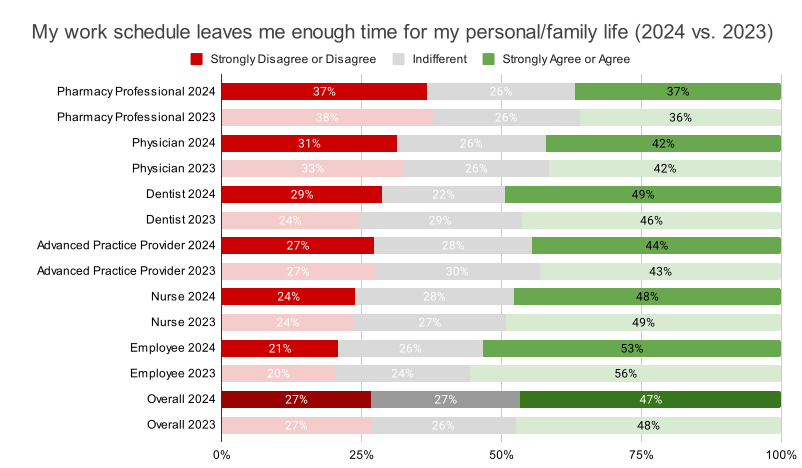
Responses to the Well-Being Index question “Please rate your level of agreement with the following statement: “My work schedule leaves me enough time for my personal/family life.”
About These Reports
This report highlights the occupations with the highest to lowest percentage of assessments that have indicated disagreement with the statement that their work schedule leaves enough time for their personal/family life in 2024 and compared to 2023.
Responses include Strongly Disagree, Disagree, Indifferent, Agree, and Strongly Agree. Responses to all versions of “Agree” were combined and responses to all versions of “Disagree” were combined for the graph. This question is available in all versions of the Well-Being Index assessment except for Medical Student & Resident / Fellow.
Connecting The Dots
Pharmacy Professionals and Dental Professionals are both among the top three professions who reported the most feeling that their role is not meaningful and that their role does not leave them enough time for personal /family life. These two items are both considered to be mitigating factors against the adverse outcomes measured for. Seeing that both of these groups have the most professionals, proportionately, reporting that there is a lack of meaning in their role and not enough of a balance between their role and personal life is notable. What kinds of support may these professionals be in need of compared to other professional groups, whose needs look different in well-being.
Physicians are among the top three highest proportion of feeling like their work does not leave them a balance between their work and personal life. We have seen a continual focus on time spent on work outside of work, admin burden, concern with boundaries between work and home, and pajama time. These are all questions that WBI partners have been focused on with their Physicians and working to alleviate. Through introducing new emr softwares, notetakers, and other strategies to try and alleviate the admin burden we continue to see partners look toward this and find effective solutions to creating a better balance between work and personal life.
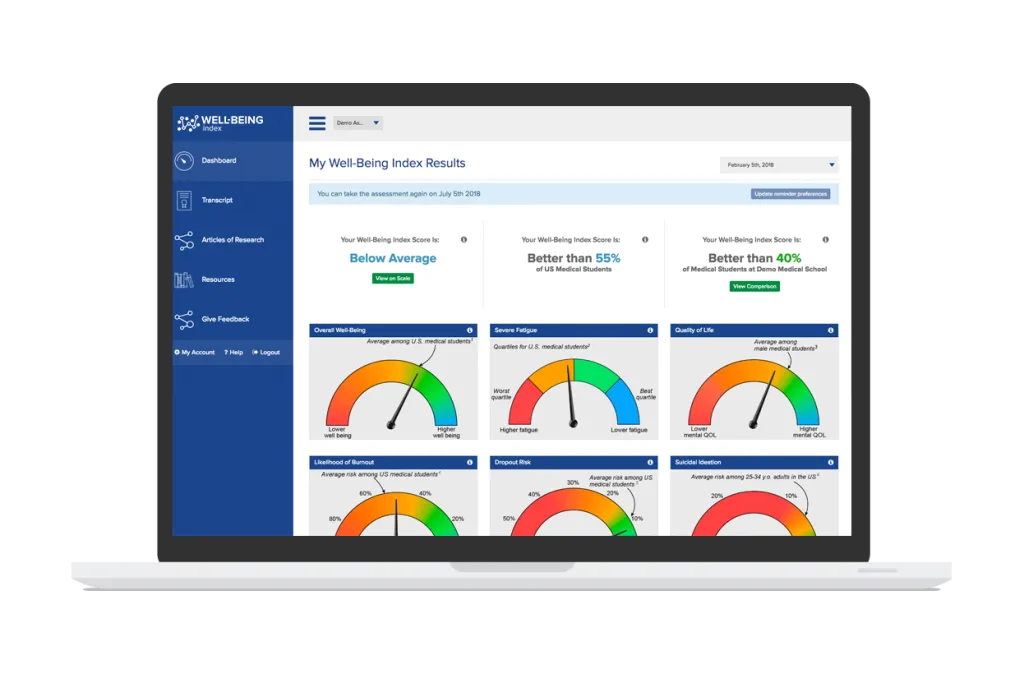
From leading national health systems to independent hospitals, small groups, and associations, the Well-Being Index provides the data and tools needed to Go Beyond Burnout. View and download the Well-Being Index case studies below.
Learn more about the Well-Being IndexExperience the Well-Being Index for yourself
Share this report: